Smt Glue plays a quiet but critical role in modern electronics assembly. It helps secure components before and during reflow soldering. A small deposit can prevent chip resistors from shifting on a fast production line. An unsuitable formulation can create voids, residue, or difficult rework.
This guide examines ten Smt Glue types for global sourcing. It compares epoxy, acrylic, UV-curable, and other practical formulations. Each type differs in viscosity, curing method, storage life, adhesion, and rework behavior. These details matter when sourcing materials across different factories and climates. A glue that performs well in a dry workshop may behave differently in humid Southeast Asia.
Reliable evaluation should begin with the technical data sheet and safety data sheet. Buyers should verify dispensing temperature, curing time, shear strength, and shelf life. Production trials should include actual boards, component sizes, nozzle dimensions, and reflow profiles. Supplier claims are useful, but measured results are stronger evidence.
Compliance also requires attention. Documentation should address applicable RoHS, REACH, chemical labeling, and transport requirements. Requirements may differ by destination and product category. No shortlist is perfect. That assumption can fail. Cost alone cannot predict manufacturing value. A lower purchase price may increase cleaning, maintenance, or rework expenses. The following overview offers a practical comparison framework for engineers, distributors, and procurement teams. It supports clearer supplier discussions and more defensible sourcing decisions. Real results still depend on process control.
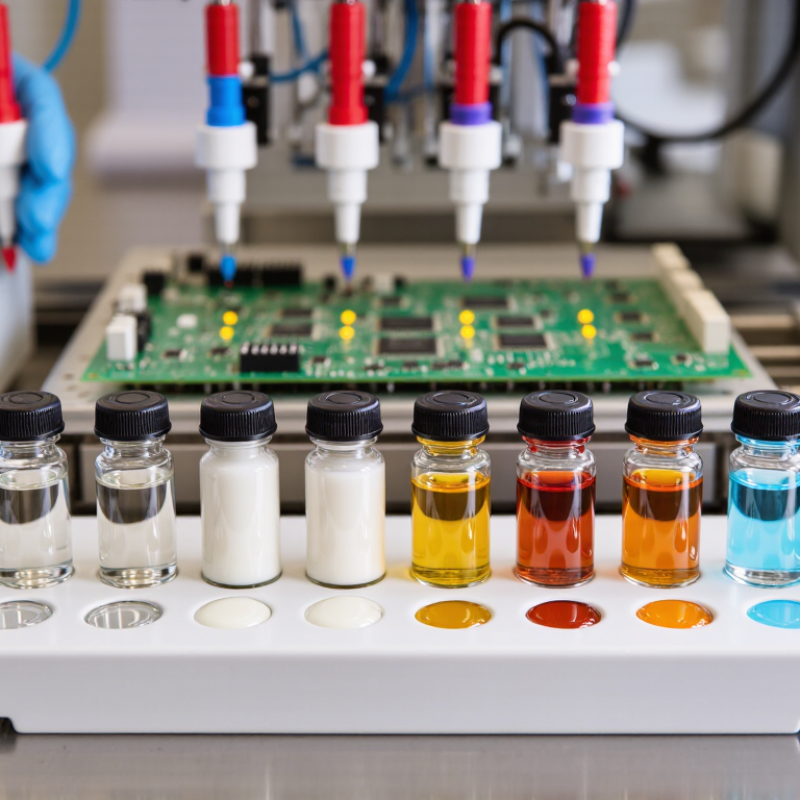
SMT glue supports component stability before soldering, especially during double-sided reflow. It fills a small but critical process gap.
The main types include epoxy, acrylic, silicone, polyurethane, cyanoacrylate, anaerobic, hybrid, UV-curable, thermally conductive, and electrically conductive adhesives. Epoxy remains common because it offers strong bonding and controlled curing. Acrylic systems may support faster processing, while silicone handles vibration and thermal movement better. Electrically conductive grades require stricter particle dispersion control.
A 2024 MarketsandMarkets assessment values the electronic adhesives market at roughly USD 5 billion. It also projects continued growth through 2028, driven by miniaturization and higher assembly density. These figures indicate demand, not guaranteed production performance. Viscosity, thixotropy, cure temperature, glass-transition temperature, and storage life still determine line behavior.
In practical sourcing, a 10-microliter deposit should remain stable beside a fine-pitch component. Excessive slump can create solder shorts. Weak adhesion can cause component movement during conveyor transfer. IPC process guidance emphasizes consistent materials, print control, and traceability across assembly operations. Suppliers should provide technical data sheets, lot records, and reflow compatibility evidence.
The classification is useful, but imperfect. Some hybrid formulas cross several categories. A low-cost adhesive may become expensive after nozzle clogging, rework, or moisture-related failures. Trial runs should measure open time, deposit height, cure profile, and post-reflow shear strength before volume purchasing.
Top 10 SMT Glue Types for Global Sourcing
Key Properties Used to Classify SMT Glue Types
SMT glue types are best compared by performance, not by chemistry alone. Epoxy, acrylic, silicone, and hybrid formulas may suit different assembly conditions. Viscosity controls dispensing accuracy and dot shape. Thixotropy helps glue stay in place beneath small components. Too much flow creates contamination risks around solder pads.
Cure behavior is equally important. Heat-cured glue needs a defined oven profile, while UV or dual-cure material may support faster production. One-part formulas simplify handling. Two-part systems can offer stronger bonding, but mixing errors remain possible. Check working life, cure temperature, and final hardness before global sourcing.
Thermal performance separates many practical options. Glass transition temperature, thermal conductivity, and coefficient of thermal expansion affect reliability during temperature cycling. Shear strength matters when components face vibration or board flexing. Electrical insulation, ionic cleanliness, moisture resistance, and reworkability also deserve documented test results. Small details matter.
Storage conditions can change the real cost. Refrigerated material may require controlled transport and strict expiration tracking. A supplier’s data sheet is useful, but it is not the whole answer. I would not rank glue by viscosity alone. A lower-cost option may waste more material through blocked needles, uneven dots, or failed curing. Factory trials should measure actual dispensing, bonding, inspection, and rework results. No single classification fits every SMT line.
Key properties used to classify SMT glue types include chemistry, curing mechanism, and process temperature. The chart shows representative curing or processing temperatures commonly used in electronics assembly; actual values vary by formulation and supplier.
Room-temperature curing systems are shown at approximately 25°C. UV-curable adhesives also require suitable light exposure and may use heat or moisture as a secondary cure mechanism.
Global SMT sourcing requires more than comparing price per kilogram. A 2024 Grand View Research analysis places Asia-Pacific above 40% of electronics adhesives revenue, reflecting strong regional production demand. The same market also shows wider use of automated dispensing and selective curing.
For buyers, the practical shortlist includes ten glue types:
Epoxy remains common for red SMT adhesive because it offers strong bonding and stable thermal performance. Acrylic cures quickly, but odor and storage control need attention. Silicone handles vibration well. Polyurethane suits flexible assemblies. Cyanoacrylate is fast, though blooming may affect appearance.
UV-curable glue supports high-speed lines, but shadowed areas can remain undercured. Thermally conductive grades help manage heat near power components. Electrically conductive and anisotropic conductive types support specialized interconnects. Low-temperature systems protect heat-sensitive parts.
A 2024 MarketsandMarkets forecast estimates the electronics adhesives market will grow at roughly 7% annually through the decade. That growth does not make every material suitable.
I would verify viscosity at dispensing temperature, curing time, glass-transition temperature, ionic cleanliness, and shelf life using supplier test data. A perfect ranking can mislead. Actual results depend on nozzle size, PCB surface, humidity, and reflow profile.
Trial batches remain necessary. Slightly higher material cost may reduce voids, rework, and placement failures.
Top 10 SMT Glue Types for Global Sourcing: Applications, Compatibility, and Selection Criteria
SMT glue selection starts with the assembly process, not the product catalog. Common options include single-component epoxy, two-component epoxy, low-temperature epoxy, UV-curable adhesive, dual-cure adhesive, thermally conductive adhesive, electrically conductive adhesive, reworkable adhesive, halogen-free adhesive, and lead-free compatible adhesive. According to IPC’s 2024 electronics industry reports, miniaturization and higher assembly density continue increasing process-control demands. Small dots can spread beneath fine-pitch components. That detail matters.
Use epoxy for standard component holding and vibration resistance. Choose low-temperature grades for heat-sensitive boards. UV formulations suit fast curing, but shadowed areas may remain under-cured. Dual-cure systems reduce that risk. Thermally conductive grades support power modules, while electrically conductive types require careful resistance testing. Reworkable formulas help repair programs, although their lower bond strength can limit harsh-environment use. Lead-free compatibility should be verified against the complete reflow profile, not only the adhesive datasheet.
Compatibility testing should include solder mask, component bodies, storage conditions, and cleaning chemistry. IPC J-STD-005 guidance supports controlled material evaluation, but production results still depend on dot shape, placement pressure, and cure time. A 2024 MarketsandMarkets report projects continued growth in the electronic adhesives market, driven by compact devices and thermal-management needs. Forecasts are useful, not proof. A practical selection matrix should record viscosity, glass-transition temperature, ionic cleanliness, cure energy, shelf life, and rework behavior. No shortlist is perfect. Your weakest process step may decide the outcome.
| Rank | SMT Glue Type | Primary Applications | Typical Dispensing / Processing | Typical Cure or Set Conditions | Material Compatibility | Reflow and Thermal Considerations | Key Selection Criteria | Limitations and Sourcing Checks |
|---|---|---|---|---|---|---|---|---|
| 1 | Single-Component Heat-Cure Epoxy SMT Adhesive |
Component holding
Reflow support
Bottom-side assembly
Secures chip components and small integrated packages before or during solder reflow. |
Stencil printing, dispensing, or pin transfer. Formulations are commonly thixotropic to resist slumping after placement. | Common cure windows are approximately 120–160°C for 30–90 minutes, depending on formulation and mass. | FR-4, solder mask, copper, nickel-plated metals, alumina, and many ceramic component bodies. Plastic compatibility must be checked for stress and chemical resistance. | Designed to retain components during reflow, but the adhesive must be qualified against the actual peak temperature and time-above-liquidus profile. | Viscosity at process temperature, dot shape, slump resistance, cure speed, glass-transition temperature, adhesion after reflow, and ionic cleanliness. | Requires controlled storage, often refrigerated or frozen. Verify thawing procedure, working life, voiding behavior, and residue near solder joints. |
| 2 | Two-Component Epoxy Adhesive |
Structural bonding
Large components
Potting
Bonds connectors, shields, stiffeners, sensors, and assemblies requiring higher structural strength. |
Metered two-part dispensing or static mixing. Suitable for beads, fillets, and localized encapsulation rather than high-speed stencil printing. | Room-temperature cure may take several hours to 24 hours; accelerated curing is commonly possible at approximately 60–120°C. | Broad adhesion to FR-4, metals, ceramics, glass, and selected engineering plastics. Surface preparation is often important. | Usually capable of good thermal resistance after full cure, but the uncured adhesive may move during reflow. Pre-cure or process sequencing is required. | Mix ratio, working life, cure profile, modulus, shrinkage, adhesion strength, thermal cycling performance, and ease of automated dispensing. | Mixing errors can reduce cure quality. Check static mixer waste, air entrapment, batch-to-batch viscosity, and exotherm in larger volumes. |
| 3 | UV-Curable Epoxy Adhesive |
Fast fixturing
Optical modules
Fine-pitch parts
Provides rapid surface cure for small components, sensors, camera modules, and precision electronic assemblies. |
Dispensing or jetting followed by exposure to ultraviolet or visible light at the wavelength specified by the formulation. | Surface cure can occur in seconds under suitable light intensity; shaded areas may remain under-cured unless the adhesive has a secondary cure mechanism. | Good adhesion is available to glass, ceramics, metals, solder mask, and selected plastics. Transparent or light-accessible joints are preferred. | Verify post-cure thermal stability and resistance to reflow. Light shadowing beneath components is a major design consideration. | Light wavelength, dose, depth of cure, optical access, yellowing resistance, shrinkage, outgassing, and final modulus. | Not suitable for opaque or deeply recessed bond lines unless a dual-cure formulation is used. UV equipment calibration is essential. |
| 4 | Dual-Cure UV-and-Thermal Epoxy |
Shadowed joints
Sensor assembly
Board reinforcement
Uses light for rapid fixturing and heat for curing areas that are hidden from the light source. |
Dispensing, jetting, or selective coating, followed by UV exposure and a thermal post-cure. | Initial light cure may take seconds; thermal completion is commonly performed around 80–150°C for a formulation-dependent period. | Suitable for many circuit-board materials, metals, glass, ceramics, and selected plastics, subject to surface-energy and chemical-resistance testing. | Generally more robust for complex geometries than UV-only products. Confirm that the thermal cycle does not damage components or create excessive stress. | Balance between UV response and thermal cure, cure depth, shadow-area conversion, CTE, modulus, moisture resistance, and rework behavior. | More complex process control than single-cure materials. Verify light dose, post-cure temperature, and residual extractables. |
| 5 | Electrically Conductive Epoxy |
Die attach
Grounding
Conductive repair
Creates an electrical and mechanical connection where soldering is unsuitable or where low-temperature joining is required. |
Dispensing, stencil printing, or die-bonding equipment. Conductive filler loading makes viscosity and nozzle selection important. | Commonly heat-cured from approximately 80–150°C; some systems are formulated for lower-temperature cure. | Metals, silicon, ceramics, and selected circuit-board surfaces. Contact surfaces must be clean and chemically compatible with the resin. | Not a universal replacement for solder. Confirm electrical resistance after thermal cycling, humidity exposure, and mechanical stress. | Volume resistivity, contact resistance, filler type, cure temperature, bond-line thickness, thermal expansion, and resistance stability. | Conductive fillers can increase brittleness, density, viscosity, and cost. Avoid unintended electrical bridges and verify insulation clearance. |
| 6 | Thermally Conductive Electrically Insulating Epoxy |
Heat spreading
Power electronics
Thermal interface bonding
Bonds heat-generating components to heat spreaders, housings, or thermal substrates while maintaining electrical isolation. |
Dispensing, screen printing, or controlled film application. Voids and excessive bond-line thickness can significantly increase thermal resistance. | Typical heat-cure ranges are approximately 80–150°C, with time determined by the resin and component temperature limits. | Aluminum, copper, ceramic substrates, FR-4, and selected engineering plastics. Check galvanic and surface-treatment compatibility for metal assemblies. | Evaluate thermal conductivity after cure, not only the resin specification. Thermal cycling can cause fatigue when CTE mismatch is high. | Through-plane thermal conductivity, dielectric strength, CTE, modulus, bond-line control, pump-out resistance, and operating-temperature range. | High filler content may reduce flow and increase dispensing pressure. Confirm insulation performance after humidity and temperature aging. |
| 7 | Electronics-Grade Silicone Adhesive |
Conformal bonding
Vibration damping
Environmental sealing
Protects and bonds components exposed to vibration, moisture, thermal movement, and outdoor conditions. |
One-part moisture-cure dispensing or two-part meter-mix application. Cure rate depends strongly on humidity, joint geometry, and product chemistry. | One-part systems may require approximately 24 hours or longer for full cure; two-part systems can cure in minutes to hours. | Generally good flexibility on FR-4, metals, glass, ceramics, and many plastics. Some silicone chemistries may impair adhesion to low-energy surfaces. | Excellent flexibility and broad temperature performance, but most silicone adhesives are not intended to hold components through standard solder reflow unless specifically qualified. | Cure chemistry, low-molecular-weight siloxane control, adhesion after humidity aging, elasticity, dielectric properties, and temperature range. | Moisture-cure products can release acidic or other by-products. Confirm electronics compatibility, contamination risk, cure depth, and reworkability. |
| 8 | Polyurethane Electronics Adhesive |
Flexible bonding
Encapsulation
Vibration protection
Used where moderate flexibility, impact resistance, and adhesion to mixed substrates are required. |
Dispensing, bead application, or meter-mix processing. One-part moisture-cure and two-part systems are both available. | Cure may range from several hours to multiple days at room temperature; heat acceleration is formulation-dependent. | Often compatible with FR-4, metals, ceramics, and many plastics, but moisture-sensitive surfaces and substrates require validation. | Select grades can tolerate operating heat and thermal cycling, but standard polyurethane is not automatically reflow-compatible. | Flexibility, hardness, moisture resistance, hydrolysis stability, adhesion to plastics, cure depth, and long-term electrical insulation. | Some systems are sensitive to moisture during storage or cure. Check yellowing, outgassing, rework, and compatibility with protective coatings. |
| 9 | Acrylic Structural Adhesive |
Metal bonding
Shield attachment
Fast assembly
Provides fast bonding for metal parts, brackets, shielding structures, and selected board-level reinforcements. |
Dispensing, bead application, film, or two-part reactive systems. Some grades are suitable for rapid automated assembly. | Reactive acrylics may fixture in minutes and reach functional strength quickly; exact cure depends on activator, gap, and temperature. | Strong adhesion is possible on metals, ceramics, and some plastics. FR-4 and solder-mask adhesion should be tested rather than assumed. | Thermal resistance varies widely. Verify performance through reflow, thermal shock, humidity, and vibration testing before SMT use. | Fixture speed, gap-filling ability, shear and peel strength, surface preparation, odor, shrinkage, and resistance to chemicals and heat. | Some chemistries can stress-crack sensitive plastics or leave volatile residues. Confirm low-ionics and electronics cleanliness requirements. |
| 10 | Cyanoacrylate Instant Adhesive |
Temporary fixturing
Wire and component restraint
Low-volume repair
Useful for rapid, localized attachment where the bond is small and the assembly will not experience severe thermal or humidity exposure. |
Precise drop dispensing or capillary application. Activators may be used to accelerate setting on difficult surfaces. | Fixture time can range from seconds to a few minutes, while full strength develops over a longer period depending on gap and humidity. | Many metals, ceramics, rubber, and some plastics; low-surface-energy plastics often require primer or a different adhesive technology. | Generally not preferred for solder-reflow exposure, high-temperature service, large gaps, or long-term high-humidity electronics applications. | Blooming control, substrate compatibility, gap size, fixture speed, temperature resistance, humidity resistance, and rework method. | Vapor blooming can contaminate optical or cosmetic surfaces. Confirm ionic cleanliness, outgassing, brittleness, and compatibility with conformal coatings. |
Global sourcing of SMT glue requires more than comparing prices. The right material depends on dispensing method, component weight, cure temperature, and board design. Common options include epoxy, acrylic, silicone, polyurethane, and UV-curable adhesives. Each type behaves differently during printing, placement, and reflow.
Ask suppliers for technical data sheets, safety documents, lot traceability, and a defined shelf life. Viscosity should match the selected needle, stencil, or jetting system. Check adhesion after thermal cycling, humidity exposure, and repeated reflow. Small changes in viscosity can cause poor transfer or component movement. They matter.
A reliable quality plan should include incoming inspection, sample testing, and retained reference samples from every lot. Measure appearance, viscosity, curing behavior, and ionic cleanliness when required. Do not approve materials only from a supplier’s certificate. Independent verification remains valuable. A low purchase price can become expensive after blocked nozzles, open defects, or rework.
Storage conditions deserve equal attention. Many SMT adhesives require refrigerated storage, commonly between 2°C and 8°C, but the supplier’s instructions must control. Keep containers sealed and record every temperature exposure. Allow frozen material to reach room temperature before opening. Do not accelerate thawing with heat. Use FIFO rotation and never refreeze opened containers. Storage mistakes are easy to overlook. Even experienced teams sometimes focus on sourcing and forget the last meter before production.
SMT glue holds components in place before soldering. It is especially useful during double-sided reflow. A small deposit can prevent movement.
Common types include epoxy, acrylic, silicone, polyurethane, and UV-curable adhesives. Specialized options include thermally conductive and electrically conductive grades. The categories are useful, but not perfect.
Choose according to the process, not chemistry alone. Check the dispensing method, component weight, cure temperature, and board design. Humidity and reflow conditions also matter.
Excessive slump may spread beside fine-pitch components. It can create solder shorts after reflow. A stable 10-microliter deposit should keep its shape near the component.
Request technical data sheets, safety documents, lot records, and shelf-life information. Ask for curing data and reflow compatibility evidence. A certificate alone may not be enough.
Trial batches should measure viscosity, open time, deposit height, and curing behavior. Test post-reflow shear strength and adhesion after thermal cycling. A trial can still miss production problems.
Follow the supplier’s specified storage range. Many materials require refrigeration between 2°C and 8°C. Keep containers sealed and record temperature exposure.
Let frozen material reach room temperature before opening. Do not speed thawing with heat. Use FIFO rotation, and never refreeze opened containers. Small storage mistakes matter.
Not always. Cheap material may cause blocked nozzles, rework, or component movement. Slightly higher material cost may reduce voids and placement failures. I would verify this with measured production data.
This guide explains the fundamentals of Smt Glue and its essential role in electronics assembly, where it helps secure components, improve placement stability, and support reliable soldering processes. It introduces the key properties used to classify different glue types, including curing method, viscosity, thermal performance, electrical characteristics, adhesion strength, and compatibility with production equipment and substrates.
The article presents ten Smt Glue types suitable for global sourcing and compares their common applications, material compatibility, and selection criteria. It also highlights practical considerations for evaluating suppliers, verifying product consistency, conducting quality control, and maintaining proper storage conditions. By considering assembly requirements, environmental exposure, processing temperatures, shelf life, packaging, and documentation, purchasing teams can select an adhesive that balances performance, reliability, cost, and supply continuity.

Anyco Automation