 Anyco Automation
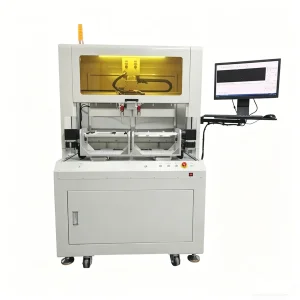
Technical Deep Dive: The Evolution of Piezoelectric Jetting in Modern Assembly
The manufacturing landscapes of consumer electronics, automotive ECUs, and medical diagnostic instruments require fluid deposition tolerances that traditional pneumatic mechanical valves can no longer sustain. The industry shift toward micro-dispensing is driven by the physical properties of modern materials—specifically, high-density solder pastes, conductive silver adhesives, and volatile UV-curable resins.
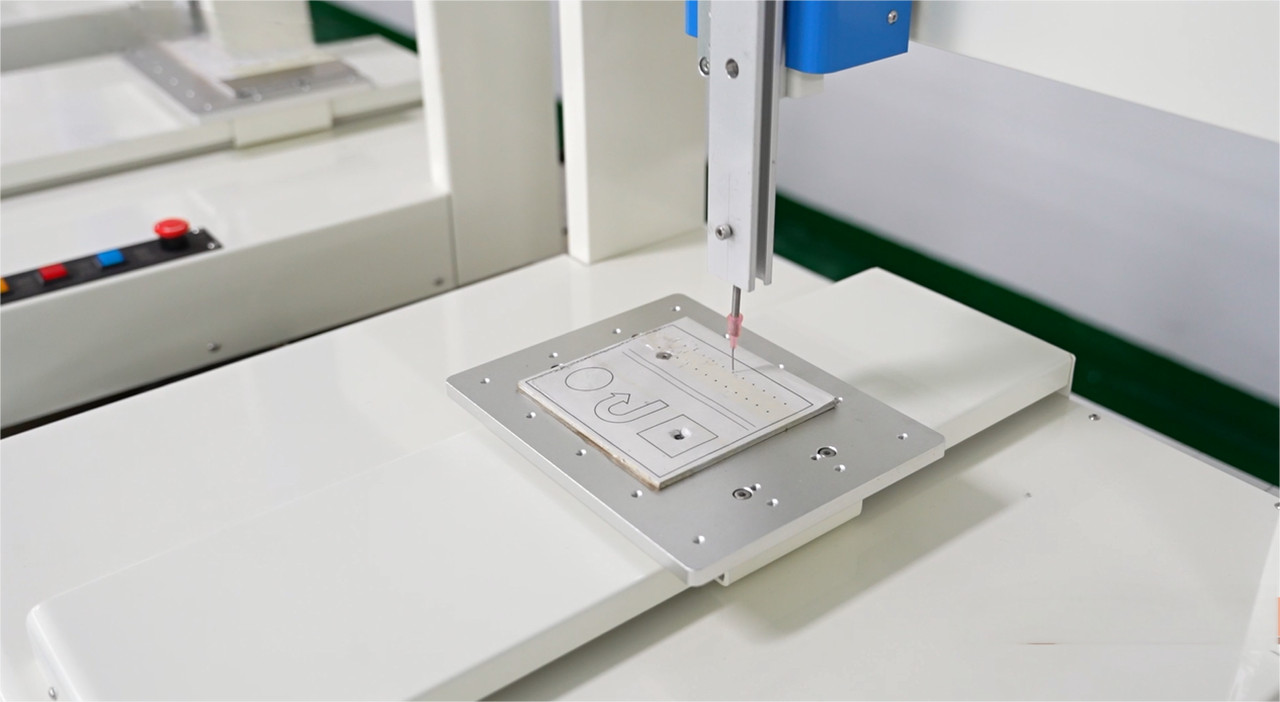
Piezoelectric jetting valves utilize the converse piezoelectric effect. By applying a controlled electric field to advanced polycrystalline materials, the valve mechanism converts electric potentials into high-frequency mechanical deformation. This mechanical movement is amplified through a precise transmission lever, actuating a needle inside the fluid channel to strike a matching tungsten carbide or ceramic seat. The fluid, pressurized at the core, is shot out of the nozzle orifice as high-velocity droplets. This eliminates Z-axis height changes and minimizes mechanical contact, preventing substrate damage while maintaining high throughput.
Why Custom Piezoelectric Valve Nozzles Form the Core of High-Yield Production
A standardized nozzle geometry is rarely optimal for diverse fluid viscosities. High-viscosity materials, like silver paste filled with metallic particulates, display non-Newtonian shear-thinning characteristics. When forced through a standard nozzle, micro-shear blockages occur, leading to flow variations and premature component wear.
Customizing nozzle geometries—including internal flow angles, surface finishes, orifice diameters (down to 50µm), and heat sink channels—allows for stable jetting operations up to 2000Hz. This tailoring guarantees stable dot-to-dot repeatability (with standard deviations under 1.5%), which is essential for placing underfills in narrow-pitch semiconductor packages.
Global Industrial Landscape & Commercial Realities
Internationally, precision micro-dispensing has transitioned from a specialized assembly technique to a critical manufacturing capability. In regions like North America and Western Europe, demand is driven by the rapid growth of automotive electronics, medical device manufacturing, and high-frequency aerospace modules. As electric vehicles (EVs) adopt larger, more complex infotainment systems and advanced driver-assistance systems (ADAS), the application of thermal gels, conformal coatings, and structural adhesives demands exceptional reliability.
Concurrently, major manufacturing centers in Southeast Asia (Vietnam, Thailand, Malaysia) and South Asia (India) are updating their production lines to support high-throughput, high-yield manufacturing. To remain competitive, these regions are modernizing legacy pneumatic systems with piezo-actuated jetting setups, aiming for improved material utilization, reduced cycle times, and minimal tool wear.